Can a person become someone different not because their genes changed or their family was different, but simply because the environment around them changed?
It is an unsettling question, but an important one. Different fears may emerge. Different desires and habits may take shape. Even a person’s sense of ease, attention, and relation to others can shift over time.
Take an extreme example: a windowless room only one metre by one metre. Two hours a day in such a space might seem bearable at first. Stretch that routine across months, and it becomes much harder to believe it would leave a person untouched. Replace the room with a glass enclosure in the middle of a busy city, where passers-by can constantly observe you for hours each day, and the question becomes sharper still. Would the person who leaves that routine be exactly the same as the one who entered it?
Most of us will never live in conditions this extreme. But that is precisely why the thought experiment is useful. It makes visible something easier to overlook in daily life: ordinary spaces are not always neutral.
The same hallway walked each morning. The same exposed desk in an open office. The same dim corridor at the end of a long day. The same apartment living room with too little daylight, or too much glare. None of these experiences may feel dramatic on their own. Yet repeated over weeks, months, and years, they can quietly shape mood, tension, attention, and behaviour.
This is one of the central insights of environmental psychology. People do not experience buildings as empty containers. Spatial conditions influence how comfortable, alert, calm, exposed, or overwhelmed we feel.
One of the field’s foundational ideas, proposed by Mehrabian and Russell in 1974, was that environments tend to affect us through broad emotional qualities such as pleasure, stimulation, and sense of control. Since then, research has continued to show that light, enclosure, views, privacy, sound, and spatial legibility all shape emotional experience.
Some of the broad patterns are now hard to ignore. Access to natural views and planting can help reduce stress. Daylight supports mood, well-being, and daily rhythm. Spaces that feel coherent and gently engaging can help restore mental focus. Privacy and control matter just as much as density: a small room is not necessarily distressing, but a small room with no retreat, no acoustic separation, and no control over exposure often is. Sound matters too. Noise is not only a technical problem; it can erode calm, concentration, and the feeling that one is in command of one’s surroundings.
None of this means architecture determines emotion in a simple or universal way. People bring memory, culture, age, routine, and personal history into every building they enter. Still, the broader direction is clear: space affects us, and often before we have found the words to describe how.
This is where Maurice Merleau-Ponty becomes especially useful. Long before contemporary research began measuring stress, attention, or emotional response, he argued that we do not encounter the world as detached minds. We experience it through the body.
We understand space through posture, movement, balance, rhythm, touch, memory, and orientation. In that sense, architecture is never just something we look at. It is something we move through, adjust to, and absorb.
Merleau-Ponty was not writing about architecture in the way designers do. He did not leave behind a checklist for ceilings, corridors, or courtyards. But several of his ideas help explain why spatial experience feels so immediate, and why its psychological effects are often bodily before they are verbal.
A well-known example from Phenomenology of Perception is the blind person’s cane. Over time, the cane is no longer felt simply as an object in the hand. It becomes part of how the person senses the world. The tip of the cane extends perception outward, helping the body register distance, texture, and resistance. Architecture often works in a similar way. A handrail, stair edge, threshold, door pull, or change in floor texture is not just a detail to be resolved technically. It becomes part of how the body finds its bearings, senses safety, and judges what is possible.
Merleau-Ponty also wrote about habit. For him, habit is not merely a mental routine but something carried by the body itself. This matters in architecture because repeated spatial experience teaches us how to move and feel without instruction. A narrow corridor can make people quicken their pace or draw in their shoulders. A generous, daylit foyer can relax the body before a word is spoken. An exposed workstation can keep someone slightly on guard all day. Over time, these are not just passing sensations. They become part of bodily routine.
He also reminds us that space is always lived from somewhere: upright, grounded, moving, turning, reaching, balanced against gravity. “Above,” “below,” “near,” and “far” are not abstract coordinates first and lived realities second. They are bodily relations from the start. This is why geometry carries emotional force. A low ceiling is never just a number on a drawing; it can feel intimate, heavy, or oppressive depending on context. A long, narrow corridor does more than connect one room to another; it can generate rhythm, anticipation, urgency, or tension. We do not merely read these conditions visually. We register them in posture and movement.
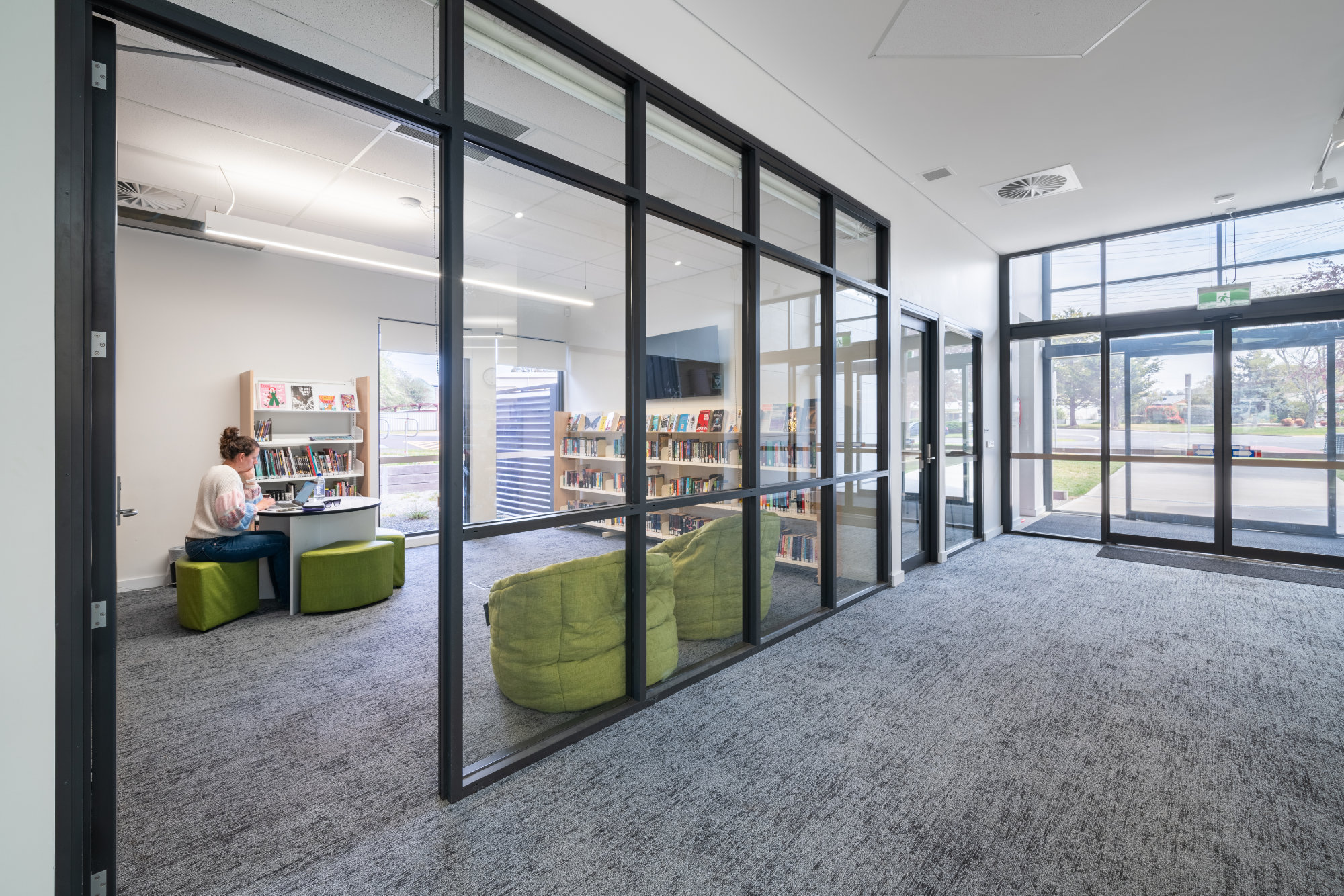
Another important thread in Merleau-Ponty’s thinking is that experience is never purely private. We do not only see; we also feel ourselves being seen. That social dimension is architectural as much as philosophical. Spaces that allow us to modulate visibility through layers, thresholds, alcoves, screened edges, or semi-private zones can support comfort and self-possession. Spaces of constant exposure often do the opposite. A glass meeting room, an overly open waiting area, or a desk with no retreat can generate self-consciousness and fatigue long before anyone names the feeling as stress.
Transitions matter for the same reason. Moving from a compressed entry into an open room can feel like release. Passing from noise into quiet can settle the nervous system. Stepping from shadow into daylight can sharpen attention or lift mood. These are not decorative effects added after the fact. They are shifts in bodily experience, and through the body they become emotional ones.
The point is not that one design move will reliably produce one emotion. That would be simplistic, and wrong. The stronger claim is more modest and more useful: architecture helps set the conditions under which certain feelings become more likely.
It can support ease or unease, attention or fatigue, refuge or exposure, calm or friction. And because most of life happens through repetition rather than spectacle, these conditions often matter most in the spaces people use every day: housing, schools, workplaces, healthcare settings, streets, lobbies, corridors, waiting rooms.
This has consequences for practice. If buildings shape experience before they are consciously interpreted, then design responsibility extends beyond image, function, and compliance. Questions of light, sound, visibility, enclosure, transition, and legibility are not secondary matters of atmosphere. They are part of how architecture is actually lived.
A good plan is not enough if daily movement through it leaves people disoriented or exposed. A generous façade is not enough if glare, noise, or constant visibility quietly wear occupants down. And a formally disciplined building is not necessarily humane if its ordinary spaces — the corridor, the stair, the workstation, the waiting area, the threshold — produce low-grade stress day after day.
Architecture rarely changes a person all at once. More often, it works slowly. It settles into routine, posture, attention, ease, and memory. That is exactly why it matters. The spaces we design do more than accommodate life; they help shape the emotional conditions in which life is lived. Before a building is analysed, it is already being felt. And before it is understood intellectually, it may already be shaping the person moving through it.
Reference: